

- Why Branded SEO Reports Matter
Branded reports transform raw data into a professional, curated product that reinforces your agency’s authority. Consistent design and structure help clients quickly understand results without re-learning the report each month. - Reporting as Storytelling (Not Just Data)
Effective local SEO reporting translates technical metrics into real business outcomes like calls, visits, and bookings. The goal is to connect SEO activity directly to revenue and customer actions. - Core Local SEO Metrics to Track
Focus on what matters most to local businesses: visibility, engagement, and conversions. Key metrics include Google Business Profile performance, Local Pack rankings, and customer actions (calls, directions, website clicks). - Google Business Profile (GBP) Insights
Prioritise discovery searches and profile interactions over vanity metrics. These indicate how often new customers are finding the business through non-branded, high-intent searches. - Local Pack & Map Visibility
Track and visualise rankings within the top 3 map results for target keywords. This is critical real estate that directly impacts local traffic and conversions. - Conversion-Focused Reporting
Move beyond traffic and report on real actions: phone calls, direction requests, and site visits. These metrics clearly demonstrate ROI and business impact. - Visualising Performance with Heatmaps
Use grid-based heatmaps to show ranking variations by location. This provides a tangible, easy-to-understand view of local SEO improvements over time. - Mobile vs Desktop Behaviour
Highlight mobile-driven local searches and user behaviour. This reinforces the importance of mobile optimisation for capturing “near me” intent. - Citation Consistency (NAP Accuracy)
Ensure consistent Name, Address, and Phone details across all listings. Reporting on citation health builds trust and shows foundational SEO work is being maintained. - Reputation & Reviews Tracking
Summarise new reviews, average rating, and response rates. Improvements here are highly visible wins that directly influence customer trust and rankings. - Executive Summary = The “So What?” Section
Always include a human-written summary that explains what changed and why it matters. Translate metrics into outcomes (e.g., increased calls, more bookings). - Adapting to AI & Zero-Click Search
Modern reporting should account for search behaviour where users don’t visit websites. Emphasise profile actions, visibility, and brand presence within search results. - Turning Reports into Client Retention Tools
Clear, transparent, and insight-driven reports build trust and strengthen long-term partnerships. The best reports don’t just inform—they guide next steps and strategy.
When you run a local business, there is a distinct satisfaction in seeing a “Closed” sign flip to “Open” or hearing the bell chime as a customer walks through the door. In the online world, that chime is replaced by data.
However, for many business owners, looking at a standard SEO report is a bit like reading a foreign language. You see acronyms like CTR, NAP, and GBP, but none of them clearly explain how many people actually bought a coffee or booked a plumbing service today.
This is where the art of reporting comes into play. Local SEO reporting is not just about dumping a spreadsheet into a client’s inbox; it is about storytelling. By using branded SEO reports, you bridge the gap between technical jargon and real-world business growth.
This guide explores how to structure these reports to prove value, build trust, and ensure your clients understand exactly how their local footprint is expanding.
The Value of Putting Your Name on the Page
It might seem like a small detail, but putting your agency’s look and feel on a report changes the psychological dynamic of the client relationship. When a business owner receives a generic PDF generated by a free tool, they view it as a utility—something they could have perhaps found themselves. When they receive a professional, white label SEO report, they view it as a curated product of your expertise.
Branding your reports ensures brand authority. It tells the client that you are the architect of their growth, not just a middleman for Google’s data. Consistency is the key here. If the report looks the same every month—using the same colours, fonts, and logic—the client spends less time trying to figure out how to read the charts and more time celebrating the actual results.
Did you know?
Research into agency-client relationships suggests that a lack of transparency and unclear reporting are among the top reasons clients leave their marketing partners. Conversely, consistent and clear reporting significantly improves client retention, as it links the agency’s daily work directly to the business’s revenue goals.
Essential Metrics for Local Search Performance
To make a report impactful, you have to filter out the noise. A local business owner usually cares about three things: Are people finding me? Are they calling me? Are they coming to see me? To answer these, your report must focus on specific local search performance indicators.
1. Google Business Profile (GBP) Insights
Your Google Business Profile (GBP) reporting should be the centrepiece. The way people interact with these profiles has shifted. While website clicks are still important, “Discovery” searches—where someone finds a business by searching for a category like “mechanic near me” rather than a specific brand name—are the true measure of SEO success.
2. The Local Pack and Map Visibility
The “Local Pack” is the group of three businesses that appear at the top of Google’s search results alongside a map. In the SEO world, we call this Local Pack visibility. Your report should visually demonstrate where the client sits in this top three for their most important geo-targeted keywords.
3. Actionable Conversion Tracking
Don’t just report “traffic.” Report actions.
- Phone Calls: How many people clicked the “Call” button directly from the map?
- Direction Requests: How many people asked for a route to the shop?
- Website Clicks: How many people moved from the map to the actual site for more info?
Visualising the “Near Me” Journey
One of the most effective ways to show Local SEO ROI is through visual data. Numbers in a table are flat, but a heatmap is alive.
Heatmaps and Grid Tracking
A heatmap shows a map of the client’s local area with a grid of dots over it. Each dot represents the client’s rank at that exact physical location. This is a powerful way to show the impact of searcher location. A business might rank #1 at their front door, but rank #8 just three blocks away. Seeing those red dots turn green over six months is one of the most “human” ways to prove that your SEO strategy is working in the real world.
Mobile vs. Desktop Trends
Local intent is driven by mobile devices. Your report should highlight the percentage of users finding the business on their smartphones. This helps the client understand the importance of mobile optimisation and fast-loading pages for those “on-the-go” moments.
Did you know?
Recent search data shows that 46% of all Google searches now have local intent.
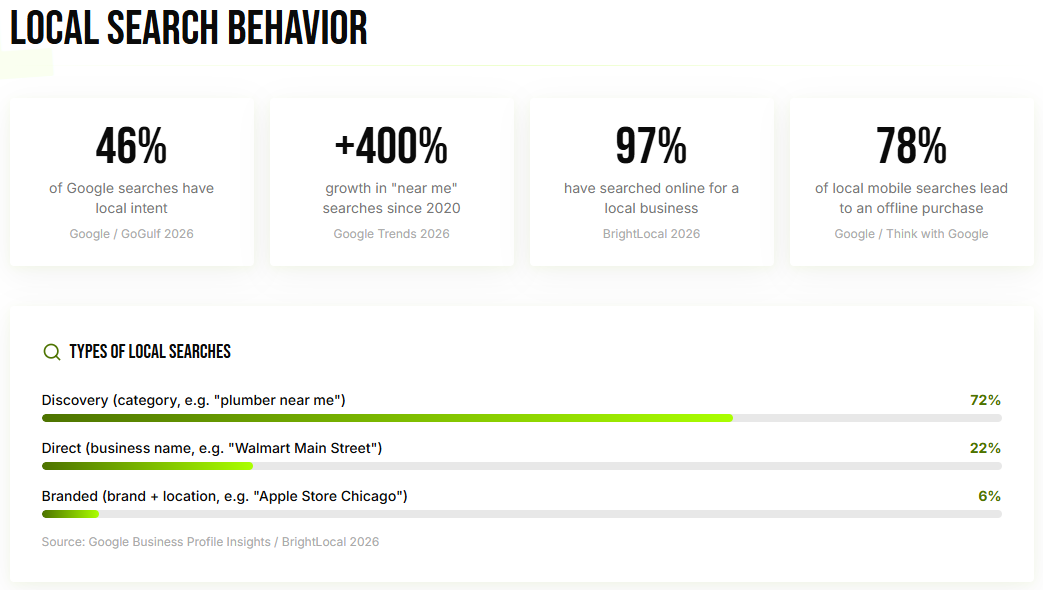
Furthermore, approximately 76% of people who conduct a “near me” search on their smartphone visit a related business within 24 hours. This highlights why tracking conversion intent is often more valuable than tracking total impressions.
Maintaining Citation Consistency and Reputation
Local SEO isn’t just about what is on a website; it’s about what the rest of the internet says about a business. This is often a “hidden” part of SEO that clients don’t see, so it is important to include it in your reports.
Citation Health
A “citation” is any mention of a business’s Name, Address, and Phone number (NAP) online. If a shop is listed as “Suite 4” on one directory but “Unit 4” on another, Google gets confused. We call this citation consistency. Including a snapshot of how many “clean” listings the client has builds confidence that the foundational work is being handled.
Reputation Management
Reviews are a primary ranking factor. Your branded report should summarise:
- New reviews received this month.
- Average star rating.
- Response rate (did the business actually reply to the customers?).
Showing a client that their average rating went from 4.2 to 4.5 is a tangible win that they can share with their staff. It moves the conversation from technical “backlinks” to real-world customer satisfaction.
The Executive Summary: The “So What?” Factor
This is the most important section of any branded SEO report, yet it is the one most often skipped by automated tools. A human should always write the executive summary.
This section should translate the data into actionable insights. Instead of saying “Your impressions increased by 20%,” try writing: “Because we optimised your service pages for ’emergency repairs,’ we saw a 20% jump in people seeing your business. This resulted in 15 extra phone calls this month compared to last.”
By providing a narrative, you align your KPI alignment with the client’s business reality. It shows you understand their industry and are not just staring at a dashboard.
Adapting to the Modern Search Landscape
The world of search is changing with the rise of AI-powered results. Google often provides “AI Overviews” that summarise local options before a user even scrolls down. This means your reporting needs to evolve too.
We are moving toward a “zero-click” reality where users get their answers without ever leaving the search results page. If a report only tracks website traffic, it might look like an agency is failing, even if the business is booming. You must educate your client through your reports that brand mentions and “actions on the profile” are the new gold standard for local success.
Did you know?
Digital marketing experts suggest that as AI-driven search becomes more common, the accuracy of your business data (NAP) across the web becomes even more critical. AI models rely on consistent data to “recommend” a business to a user in a conversational search.
Partner with VM Group White Label Services for white-label SEO, PPC, web design, and more.
Focus on growing your business—we’ll handle the rest.
Conclusion: Turning Data into Partnerships
A report should never be an ending point. It should be the start of a conversation about the next month’s strategy. When you present Local SEO results through a branded, well-structured format, you are doing more than just showing off numbers. You are proving that you are a partner in the client’s success.
By focusing on transparent reporting, search intent, and the human element, you ensure that your clients don’t just see a bill every month—they see an investment that is actively growing their presence in the local community. In the end, the best report is the one that makes a business owner feel confident, informed, and ready to take on the next month of growth.